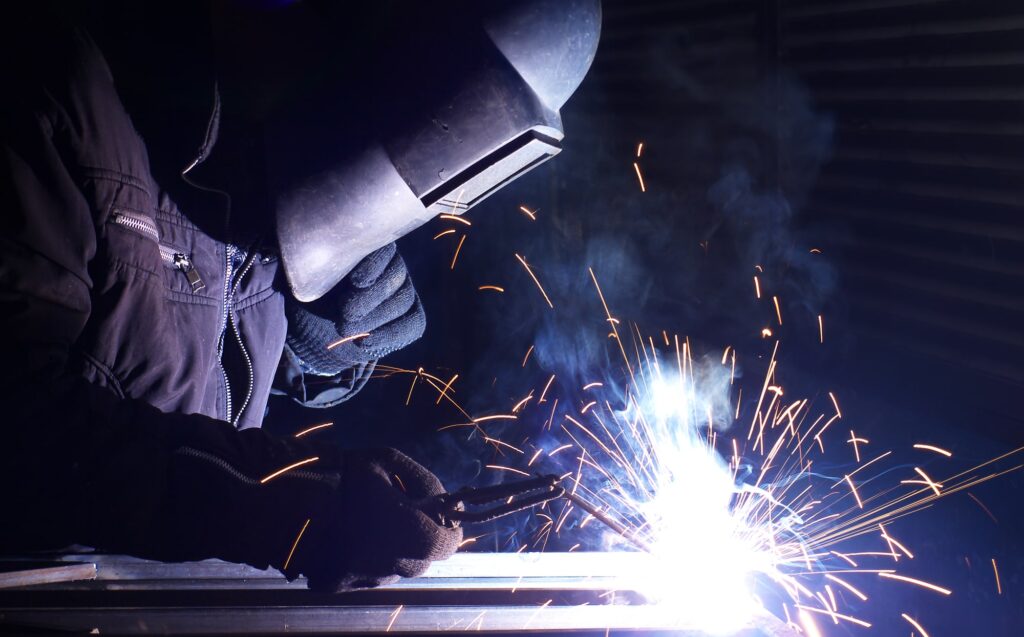
Welding is the backbone of modern manufacturing and construction, turning simple metal pieces into complex, durable, and highly functional structures. At Newport Industries, we pride ourselves on utilizing a diverse arsenal of advanced welding techniques to meet the precise demands of every project.
We don’t just weld—we fuse materials with precision. Here is an in-depth look at the four core welding methods we master and deploy daily: MIG, TIG, Robotic, and Laser Welding.
1. MIG Welding (Gas Metal Arc Welding)
MIG welding is often called the “workhorse” of the industry. It is a semi-automatic process prized for its speed, simplicity, and efficiency across a wide range of materials.
The Process
MIG welding uses a continuously feeding solid wire electrode that is automatically pushed through a welding gun. An inert or semi-inert shielding gas (typically Argon or a mix of gases) flows around the wire and the weld puddle, protecting the molten metal from atmospheric contaminants like oxygen and nitrogen.
Key Characteristics & Applications at Newport
| Characteristic | Detail |
| Speed & Efficiency | Very fast deposition rates, making it ideal for long weld seams and high-volume production. |
| Ease of Use | Relatively simple to learn and execute compared to TIG. |
| Materials | Excellent for welding thicker sections of carbon steel, stainless steel, and aluminum. |
| Best For | Structural steel fabrication, large vessel manufacturing, and high-speed assembly line work where aesthetics are secondary to speed and strength. |
In short: If the job requires strength and speed across thick materials, MIG welding is our go-to solution for reliable, robust joints.
2. TIG Welding (Gas Tungsten Arc Welding)
TIG welding is the master of precision and purity. It is a highly demanding, manual process that yields welds of exceptional quality and aesthetic beauty.
The Process
TIG welding utilizes a non-consumable tungsten electrode to create the arc. The welder holds a filler rod manually in the other hand and adds material to the weld puddle as needed. A pure inert shielding gas (usually $100\%$ Argon) protects the weld area.
Key Characteristics & Applications at Newport
| Characteristic | Detail |
| Precision & Control | Offers the highest level of control over the heat, penetration, and filler material. |
| Weld Quality | Produces the cleanest, strongest, and most aesthetically pleasing welds with no splatter or flux residue. |
| Materials | Essential for exotic and thin metals, including aluminum, magnesium, copper alloys, and thin-gauge stainless steel. |
| Best For | Aerospace components, food-grade equipment (where sanitation is key), intricate piping systems, and any high-visibility parts requiring a flawless finish. |
In short: TIG welding is utilized when flawless aesthetics and critical joint integrity on sensitive or thin materials are required.
3. Robotic Welding (Automated Arc Welding)
Robotic welding leverages the speed and reliability of MIG and TIG, but replaces the human operator with a sophisticated, computer-controlled mechanical arm.
The Process
A programmable robotic arm is fitted with a standard welding torch (typically MIG, sometimes TIG). The robot follows a precisely programmed path to execute the weld. Sensors and vision systems are often incorporated to ensure accuracy and adapt to slight variations in material placement.
Key Characteristics & Applications at Newport
| Characteristic | Detail |
| Repeatability | Near-perfect consistency and uniformity. The robot executes the exact same weld path and speed every time. |
| Volume & Speed | Operates continuously without fatigue, drastically increasing throughput for mass-produced components. |
| Safety | Moves the operator away from the arc, fumes, and heat, improving workplace safety. |
| Best For | High-volume production runs of parts with simple to moderately complex weld joints, such as automotive components, industrial machinery frames, and repeatable batch jobs. |
In short: Robotic welding ensures unmatched consistency and speed for high-volume, repetitive work, guaranteeing every part meets the exact same quality standard.
4. Laser Welding (Laser Beam Welding)
Laser welding represents the cutting edge of material joining, offering extreme speed and minimal thermal impact.
The Process
This method uses a highly focused beam of intense light (a laser) to generate the heat needed for fusion. The concentrated energy allows for deep, narrow welds at very high speeds while minimizing the surrounding heat-affected zone (HAZ). This low heat input is key to preventing material warping or deformation.
Key Characteristics & Applications at Newport
| Characteristic | Detail |
| Precision & Minimal Distortion | The focused beam allows for pinpoint accuracy on small components. The low heat input prevents most material warping, which is crucial for precision parts. |
| Speed | Extremely fast process, fusing materials much quicker than traditional arc methods. |
| Weld Geometry | Produces deep penetration with a high aspect ratio (deep and narrow), ideal for specialized joints. |
| Materials | Used across metals, particularly in joining dissimilar metals and for highly sensitive or complex geometries. |
| Best For | Medical devices, fine electronics casings, automotive transmission parts, and any component requiring high-strength welds with zero visible distortion. |
In short: Laser welding is reserved for the most intricate, speed-critical, and warp-sensitive projects where traditional methods would be too slow or too damaging to the surrounding material.
Fusing Expertise with Technology
At Newport Industries, our commitment to quality is upheld by our diverse welding expertise. By mastering these four distinct methods—from the robust efficiency of MIG to the precision artistry of TIG, the consistent power of Robotic systems, and the micro-precision of Laser technology—we ensure that we select the right tool for every job.
This technological versatility allows us to deliver solutions that are not just strong, but are optimized for cost, speed, aesthetics, and material integrity, consistently meeting the EPIC standards our clients expect.